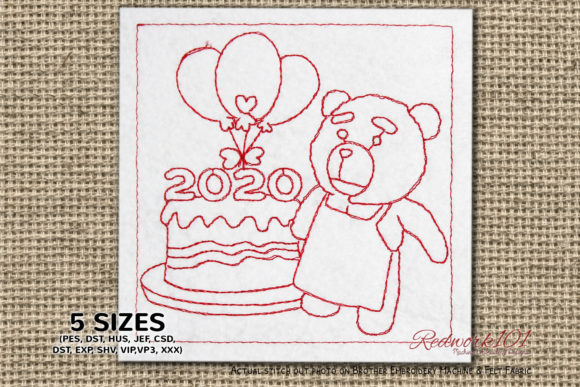
Teddy Baking New Year Cake Redwork
First Impression: Festive, Whimsical, and Instantly Recognizable
As an embroidery designer who’s prepped over 200 craft fair booths—from snowy winter markets to sun-drenched summer fairs—I instantly felt the charm of Teddy Baking New Year Cake Redwork. It lands squarely in the “festive whimsy” lane: warm, approachable, and full of handmade joy. The redwork style gives it that classic, slightly rustic authenticity—think vintage kitchen linens meets modern holiday cheer. It’s not overly cutesy or cartoonish; instead, it balances playful storytelling (a teddy bear baking!) with clean line work and intentional negative space. That makes it feel premium without demanding perfection—and that’s gold for craft fair sellers.
Where It Shines: Product-by-Product Reality Check
Tote bags: A standout. Teddy Baking New Year Cake Redwork reads clearly at 4–5 inches wide—ideal for center-front placement on natural canvas or unbleached cotton totes. The redwork contrast pops against light fabric, and the narrative invites conversation (“Oh! Is that for New Year’s?!”).
Aprons: Excellent focal point above the pocket or centered on the bib. Its vertical composition suits apron silhouettes naturally, and the baking theme reinforces utility—customers love thematic cohesion.
Tea towel embroidery: Highly effective, especially on medium-weight linen or cotton blends. Avoid ultra-textured towels unless you test stabilizer first—the design’s fine lines can blur on heavy weaves. Stick to smooth, tightly woven fabrics for crisp clarity.
Embroidered patches: Perfect size and detail level for a 3–3.5" patch. The optional box stitch adds polish if used as a sew-on badge for kids’ backpacks or boutique gift sets.
Caps & curved surfaces: Proceed with caution. The teddy’s rounded form and cake details may distort on low-profile caps. Reserve for structured trucker hats or flat-bill styles—and always test hoop placement and tension on scrap fabric first.
Pillow covers & small pouches: Strong performers. At 3–4", Teddy Baking New Year Cake Redwork retains charm and legibility. On pillow covers, it adds instant personality without overwhelming scale.
Printable mockups & Etsy listings: This design photographs beautifully—especially with warm lighting and minimal props (a real cinnamon roll nearby? Yes, please). Its clear subject and seasonal relevance boost click-through rates for digital embroidery file listings and finished product photos alike.
Production Practicality: What Makes It Craft-Fair-Ready
Teddy Baking New Year Cake Redwork is refreshingly straightforward—not overloaded with dense fill areas or micro-detailing. That means faster hooping, fewer thread breaks, and reliable repeatability across batch production. It works well as both a small accent (e.g., corner of a tea towel) and a bold focal piece (centered on a market bag). No tiny lettering to vanish at smaller sizes, no fragile stems or isolated threads prone to snagging. That simplicity translates directly to booth efficiency: less troubleshooting, more selling.
Careful-Use Notes Every Designer Should Know
- Dense stitch areas: The cake layers and teddy’s facial features may carry moderate density—confirm stitch count before scaling down below 3".
- Fabric texture matters: Avoid highly napped or looped terry cloth; opt for smooth cotton, linen-cotton blends, or quilting-weight fabric for best definition.
- Dark fabric warning: Traditional redwork relies on contrast. If stitching on navy, charcoal, or black, switch to cream or light gray thread—and verify visibility in person, not just on screen.
- The optional box stitch: As noted in the description, it’s decorative, not structural. Skip it entirely on textured surfaces or when prioritizing speed over framing.
Booth Impact & Buyer Psychology
In a crowded craft fair aisle, Teddy Baking New Year Cake Redwork draws attention through warmth and narrative—not flash. Customers pause longer on items that tell a story, and this design does exactly that: nostalgia, celebration, and gentle humor all in one motif. It elevates perceived value—handmade products featuring thoughtful, cohesive designs consistently command higher price points. For Etsy sellers and small shop owners, it strengthens brand consistency across collections (think matching aprons + tea towels + patches), while also standing alone as a joyful, giftable item.
Pro Designer Checklist Before You Stitch
- Test the embroidery file on scrap fabric matching your intended product—same weight, weave, and color.
- Verify thread colors against your base fabric under natural and booth-style lighting.
- Review spacing and margins—especially if combining with text or other motifs.
- Confirm hoop size compatibility; don’t assume it fits standard 4x4 unless verified.
- Inspect stitch density in critical zones (teddy’s face, cake frosting) for potential puckering on lightweight fabric.
- Choose stabilizer wisely: cutaway for stretchy knits, tear-away for stable wovens, and fusible + tear-away combo for textured towels.
- Create at least one real-world mockup—not just a digital preview—before committing to 50 tote bags.
- Compare how the design reads on multiple fabric colors (cream, oat, sage, navy) to expand your product palette confidently.
- Confirm commercial licensing terms apply to your use case—especially for resale as a finished product or digital embroidery file.
Final Thought: A Seasonal Staple With Year-Round Appeal
Teddy Baking New Year Cake Redwork isn’t just a holiday novelty—it’s a versatile, emotionally resonant machine embroidery design built for real-world making. It bridges toys and embroidery with lighthearted sincerity, performs reliably across common craft fair products, and rewards thoughtful execution with strong buyer engagement. Whether you’re an Etsy seller launching a New Year collection, a boutique maker refreshing seasonal gifts, or a Cricut + embroidery hybrid crafter building design assets—this is one of those rare pieces that feels handmade *and* market-ready from the first stitch.