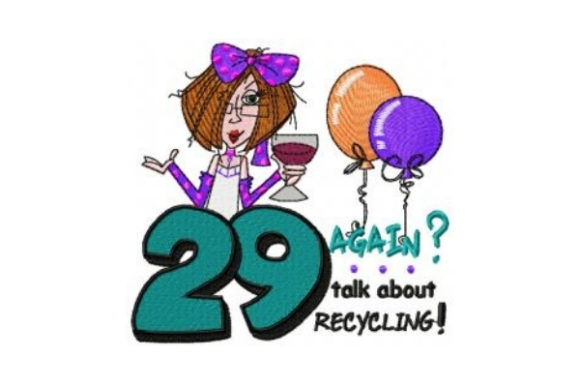
29 Again Talk About Recycling
A Practical Embroidery Designer’s Review for Small Business Merch
As an embroidery designer who’s digitized and stitched thousands of designs for cafés, boutiques, bakeries, florists, pet brands, and handmade studios, I approach every new machine embroidery design with two questions: “Will it translate cleanly across real-world fabrics?” and “Does it strengthen—rather than dilute—my client’s brand identity?” When I first saw 29 Again Talk About Recycling, my instinct was to pause. The title hints at wit, sustainability, and a wine-loving audience—but does it hold up under the needle? Let’s break it down.
First Impression: Playful, Purposeful, and Professionally Approachable
29 Again Talk About Recycling lands as friendly and intentional—not overly rustic, not sterile, not cartoonish. It feels modern enough for a curated boutique or eco-conscious café, yet warm enough for a family-run winery or handmade soap studio. The phrase “Talk About Recycling” suggests values-driven storytelling, while “29 Again” adds personality and memorability—ideal for small business merch that aims to resonate, not just decorate. For wine-adjacent brands (think vineyard gift shops, tasting room apparel, or local wine clubs), it’s a subtle nod to both lifestyle and responsibility—no heavy-handed slogans required.
Real-World Performance Across Business Applications
This design shines where clarity and charm intersect. As an embroidered patch, it holds strong on denim jackets, tote bags, and aprons—especially when paired with natural fibers like cotton canvas or linen-blend twill. On staff uniforms, it reads well as a chest logo or sleeve accent, offering visual interest without overwhelming clean lines. For cap embroidery, position it slightly above center front to avoid distortion from the crown curve; its balanced letter spacing helps maintain legibility even at 2.5” width.
On tote bag design, 29 Again Talk About Recycling works beautifully as a single focal mark—no extra icons or vines needed. Its rhythm guides the eye naturally, supporting brand recall over time. As an apron embroidery element, it conveys craftsmanship and care—key for bakeries, florists, or craft studios whose teams wear branded gear daily. And for Etsy sellers or handmade product labels, it adds a thoughtful, human-scaled detail that elevates unboxing and shelf presence.
Where to Use It Thoughtfully
Like any text-dominant design, 29 Again Talk About Recycling demands attention to scale and surface. Avoid shrinking it below 1.75” wide for patches—it risks losing letter distinction, especially on textured fabric or dark uniforms where thread contrast matters. On curved surfaces like cap fronts or rounded mugs (if used for embroidered sleeves on heat-transfer mockups), confirm that kerning remains consistent—tight letters may crowd, wide ones may gap.
High stitch density can be a concern if the original digitization includes tight fills or overlapping outlines. Always test stitch on your target fabric: lightweight cottons may pucker; fleece or terry cloth may swallow fine details. If your version includes decorative flourishes (e.g., leaf motifs or vine accents implied by “recycling”), inspect whether those elements simplify cleanly at smaller sizes—or whether they’ll require manual editing before production.
Brand Identity Impact: More Than Just a Phrase
For small businesses, consistency is currency—and 29 Again Talk About Recycling supports that. It doesn’t shout; it invites conversation. That builds trust. Customers remember brands that reflect shared values, and this design quietly signals environmental awareness without sacrificing warmth or wit. Used alongside other design assets—like a simple monogram or minimalist icon—it creates visual hierarchy: personality upfront, professionalism underneath.
It also raises perceived value. A well-executed embroidered patch or custom apparel piece feels more intentional—and more valuable—than printed alternatives. That perception carries through to customer gifts, event merch, and wholesale packaging accents. When stitched cleanly, 29 Again Talk About Recycling tells people: “We care about how things are made—and how they’re worn.”
Essential Embroidery Designer Notes Before Production
- Test in black and white first. Confirm readability and balance without color distraction.
- Check small patch viability. Resize to your most common patch dimensions (e.g., 2” x 1.25”) and verify spacing holds.
- Review thread color contrast. On dark uniforms or navy totes, opt for high-contrast thread—ecru or olive may fade; charcoal or forest green often reads stronger.
- Inspect spacing and kerning. Ensure “29 Again” doesn’t visually separate from “Talk About Recycling” at production size.
- Confirm hoop size and file compatibility. The description notes “this machine embroidery design comes with multip”—verify which formats (PES, DST, JEF, etc.) are included and whether your software supports them.
- Test on real fabric with proper stabilizer. Lightweight cutaway works best for structured items like caps and aprons; tear-away suffices for stable cotton totes.
- Create a printable mockup for client approval. Show it scaled on actual garment photos—not just blank templates.
- Compare beside existing design assets. Does it align tonally with your logo, website, or packaging? If not, consider simplifying or reworking the layout.
- Confirm commercial licensing. Since this is intended for small business merch, commercial embroidery, and resale items, ensure the digital embroidery file permits business use—many free or low-cost files restrict resale rights.
Ultimately, 29 Again Talk About Recycling isn’t just a clever phrase—it’s a versatile, values-aligned tool for small business owners building authentic connections. Whether you’re stitching for a weekend farmers’ market stall or launching a full line of handmade product packaging, this machine embroidery design earns its place in your workflow—if you treat it with intention, test it with rigor, and let its quiet confidence speak for your brand.